
AI Sales Coaching vs. Traditional Sales Training for Revenue Acceleration
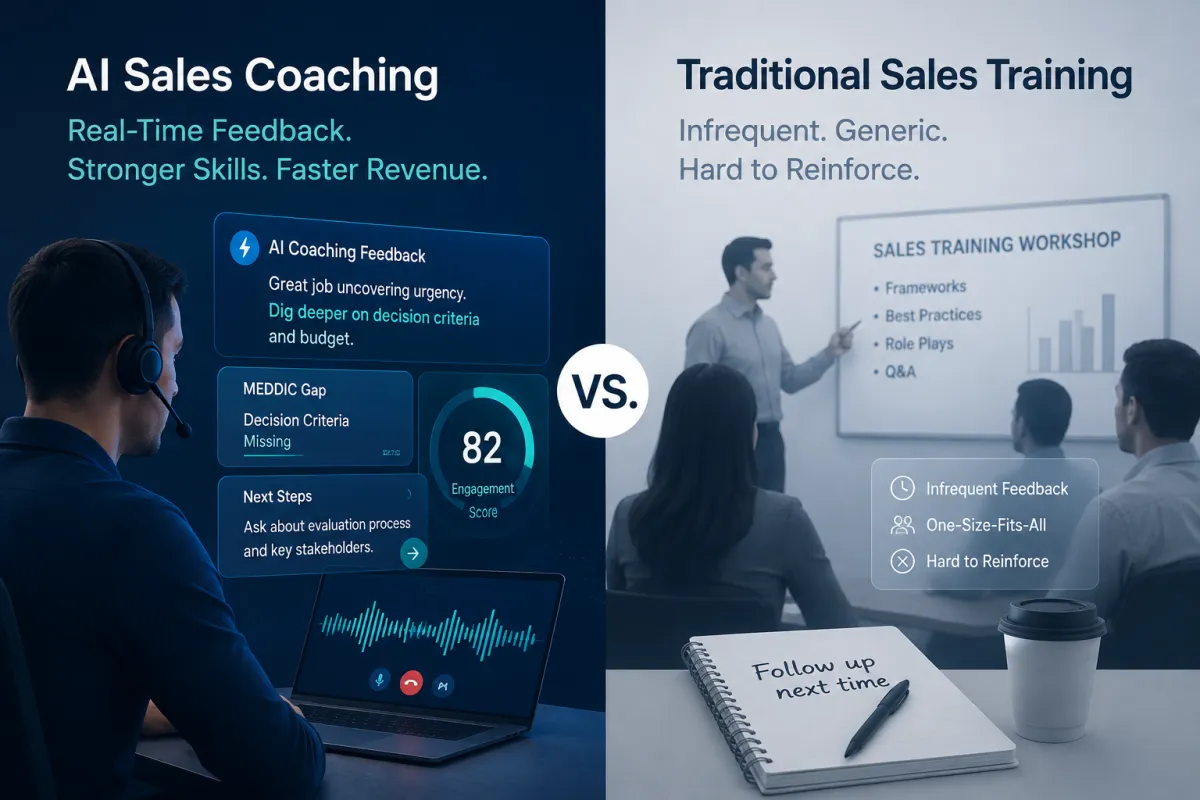
AI sales coaching is an automated software solution that analyzes sales interactions to provide immediate, data-driven feedback to representatives. Unlike traditional skills training workshops followed by period reinforcement activities, this technology processes call transcripts or recordings in real-time to identify specific skill gaps and suggest actionable improvements. Implementing AI sales coaching helps organizations bridge the performance gap between periodic training sessions and daily execution, ultimately accelerating revenue growth by showing exactly how AI sales coaching improves skill and revenue growth.
Key Takeaways
AI sales coaching analyzes live call transcripts to provide immediate, data-driven feedback for sales representatives.
Traditional sales training often fails due to manager bandwidth constraints and infrequent, scheduled workshop delivery.
Automated platforms leverage frameworks like MEDDIC to provide objective gap analysis on every discovery call.
Purpose-built AI platforms outperform generic LLMs by integrating company-specific context and value-based selling methodologies.
Effective coaching tools prioritize speed, specificity, and psychological safety to drive sustainable team skill development.
Defining AI Sales Coaching and Its Differences from Traditional Sales Training
AI sales coaching is a software-driven process that analyzes live sales calls to provide actionable feedback immediately after a sales call ends. Traditional sales training typically involves workshops, supporting content, and manager-led 1:1 sessions delivered on a fixed schedule, independent of recent call performance.
The difference isn't that the AI takes the place of human feedback. The primary distinction lies in the delivery mechanism: traditional training provides uniform material to all representatives and limited feedback, whereas an AI sales coach continuously addresses specific gaps identified in each specific representative's most recent call with specific prospects. This helps sales reps quickly see opportunities to improve on observed gaps on an ongoing basis.
Read our guide, What is AI Sales Coaching? to learn more.
Why Traditional Sales Coaching Often Fails to Change Rep Behavior
Traditional sales coaching to reinforce skills training fails to change behavior because it depends almost entirely on manager bandwidth, and most managers are stretched thin across a growing team while constantly managing company expectations.
Ask any VP of sales how often a scheduled 1:1 turns into a real skill development conversation instead of a forecast update. The honest answer is rarely. The same gap shows up when the meetings come from outside the company. In our analysis of why 93% of outsourced SDR programs fail, the breakdown wasn't the SDRs. It was the AEs who never prepared for what the SDRs booked. Skills coaching matters, but it isn't urgent, so it keeps losing to whatever deal or manager pressures that need attention that week.
Furthermore, sales representatives who feel their skills are being scrutinized may experience reduced psychological safety, leading them to hide weaknesses during manager-led sessions. Reps naturally spend a lot of cycles during coaching sessions with managers in an attempt to demonstrate their sales competencies and hide weaknesses. Even when coaching sessions do happen, the feedback and the rep’s opportunities to develop may not optimally surface or land.
Evaluating Sales Manager Coaching Capacity and Its Impact on Skill Development
Realistically, a manager can offer 30 to 60 minutes of coaching per rep each month, and even that time frequently becomes a forecast or pipeline review rather than actual skills coaching. To be a great coach, the manager must listen to a recorded call or listen to a rep’s long-winded recap, which can be an inefficient use of the manager's and rep’s time. That kind of headwind relative to a sales manager’s coaching capacity is not enough to make workshop content stick, and the team’s change management and skill development goals will suffer.
How AI Sales Coaching Analyzes Discovery Calls to Improve Sales Outcomes
Current Sales Intelligence markets offer several approaches to automated coaching. After a discovery call concludes, the representative uploads a transcript to the AI coaching platform for immediate analysis of deal relevance, urgency, and engagement. After upload, analysis runs in a couple of minutes, so the rep gets a full breakdown of the deal, covering buyer relevance, urgency, engagement, and pushback, plus specific questions for the next call.
The rep gains insights into the aspects of the call that went well, along with those that did not get surfaced. These gaps are the missing details that add risk to deals, slow deals down, and often lead to “no decision” by the prospect. By understanding what the rep missed, they make connections back to reinforce the selling skills both for the current opportunity and (more importantly) all future discovery calls.
Some AI Coaching tools allow the rep to role-play (like Gong or Tandem, as examples), based on this feedback. Through practice, the rep can further reinforce and develop the skill. While these tools can reduce the burden on the manager’s time, they also consume reps’ time, and this can lead to adoption challenges.
There are some AI coaching platforms that attempt to prompt the seller during the call. Adoption of these tools is very challenging, as many reps find these distracting rather than helpful. For most complex B2B sales, it’s more important that reps stay fully present with the prospect instead of splitting attention between the live discussion and coaching prompts.
The AI coaching tools that help reps the most are simple, clear, and actionable, documented and delivered immediately after the call. This timely, continual feedback, combined with periodic live manager coaching, is repeatable, sustainable, and delivers the change that has eluded sales training initiatives for decades.
How Automated MEDDIC Scoring Enhances Sales Intelligence
AI sales coaching platforms typically leverage established sales methodologies, such as BANT or MEDDIC, to conduct discovery call analysis. Let’s assume MEDDIC, as an example. In a modern AI Sales Coaching solution, the rep or manager doesn’t fill out a MEDDIC scorecard or job aid. Forms are friction in the sales enablement world.
MEDDIC coaching built into an AI system typically means the transcript gets scored automatically, say 0 to 10, across every crucial component, including metrics, economic buyer, decision criteria, decision process, identifying pain points, and champion identification. Alongside the score sits a gap analysis showing what the rep confirmed with the prospect on the call and what they potentially missed.
This automated gap analysis transforms a static scorecard into actionable guidance for the next sales interaction. If a rep confirms the prospect isn't the sole decision maker but never asks who else is involved, the system flags the gap and suggests a follow-up question. Run this process across every call, and reps get ongoing value-based selling instruction that never waits on a manager's calendar.
Why Using ChatGPT or Claude Differs from Purpose-Built AI Sales Coaching Platforms
While ChatGPT or Claude can summarize text and provide coaching feedback from transcripts, it lacks the specialized training required for effective AI sales coaching. The answer is that two problems will show up fast.
Using generic Large Language Models (LLMs) for sales coaching presents two primary challenges: a lack of company-specific context and the requirement for complex prompt engineering. While it might be possible to provide context to the LLM, it is challenging to maintain across even a small sales team. More importantly, without the context, reps notice the generic feedback and tune out. Even with context loaded in, getting something useful back out requires the rep to be a decent prompt engineer, a skill most sellers don't have. The likelihood of all sellers on a sales team achieving competency in prompt engineering is low. And, taking more than 5-10 minutes to get useful feedback is additional friction, and that’s enough to jeopardize sustained adoption.
A platform trained by default on your solutions, case studies, and value proposition, plus applied MEDDIC (or other framework) and value-based selling methodology, starts from a different place. It already knows your business before the rep opens the app, and it knows how to coach across all sellers, not just summarize or generically analyze a transcript.
Key Features to Evaluate in an AI Sales Coaching Platform
Three things separate well-built sales coaching software from a feature bolted onto an existing tool: speed, specificity, and ownership.
Speed - Insight should land within minutes of a call ending. Otherwise, the details get stale, and coaching effectiveness is lessened.
Specificity - The platform should be trained on your business rather than deliver generic coaching.
Ownership - A tool built mainly for manager oversight or preservation of their time gets resisted, while a self-serve tool built to help the rep gets used. Coaching tools that deliver great insights in a psychologically safe environment can quickly scale selling skills across sales teams.
Revenue Growth Agent's Discovery Conversion Agent was built around that standard. RGA is an AI-native sales platform, not a legacy tool with AI added on later. Upload a discovery call transcript and RGA returns MEDDIC coaching, a gap analysis, and next-call questions in about two minutes, grounded in your own solutions. If your sales training investments are yielding results, book a demo and see what immediate post-call coaching looks like against one of your own transcripts.

Frequently Asked Questions
How does AI sales coaching improve revenue growth for modern organizations?
AI sales coaching improves revenue growth by providing immediate, data-driven feedback on real discovery calls. This process identifies specific skill gaps, suggests actionable improvements for each representative, and impacts top-of-mind deals. By addressing these gaps in real-time, organizations reduce deal risk and ensure that sales teams consistently apply value-based selling methodologies in every interaction.
What distinguishes purpose-built AI coaching from generic LLMs?
Purpose-built AI sales coaching platforms are trained on company-specific context, including case studies and value propositions. Unlike generic Large Language Models, these platforms do not require complex prompt engineering from the user. They provide specialized, actionable guidance that is immediately relevant to the business, which significantly increases adoption rates among sales representatives.
How does automated MEDDIC scoring support sales enablement?
Automated MEDDIC scoring transforms static scorecards into dynamic, actionable guidance by analyzing call transcripts for key components like decision criteria and pain points. This system identifies missing details and suggests follow-up questions for the next call. It removes the friction of manual forms and provides ongoing coaching without manager intervention.
Why is speed important for effective sales coaching?
Speed is critical because coaching insights must land within minutes of a call ending to remain relevant. When feedback is delayed, details become stale and the effectiveness of the coaching diminishes. Immediate, post-call analysis ensures that representatives can apply learnings to future discovery calls while the interaction is still fresh.