
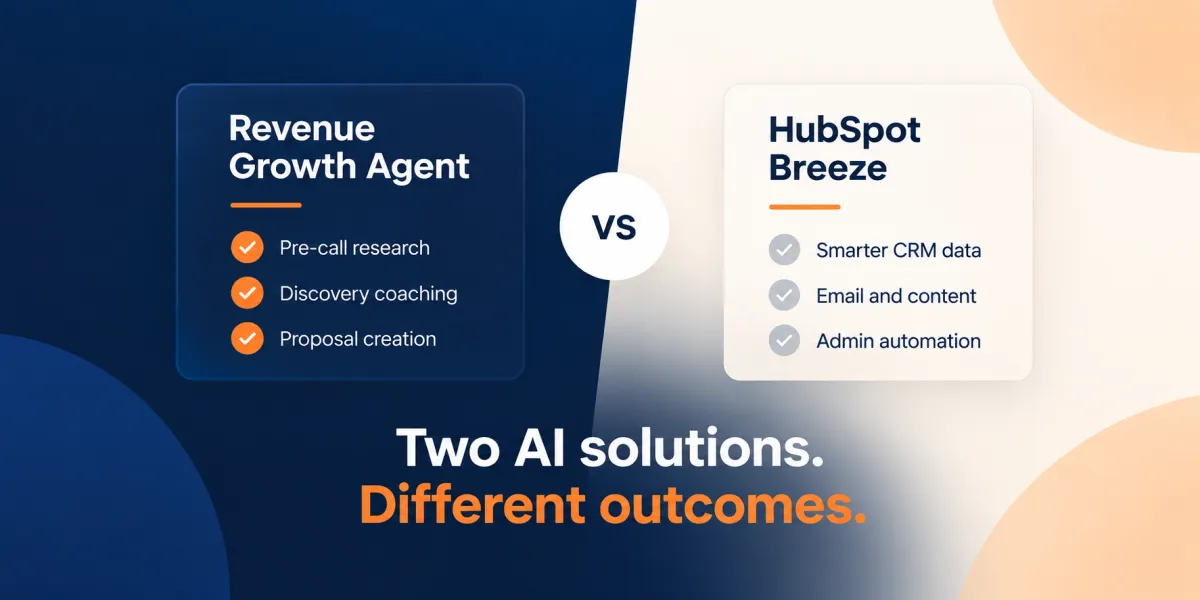
Revenue Growth Agent vs HubSpot Breeze for AI Sales: Which Do You Actually Need?
Someone has probably told you that Breeze covers your AI needs. If your problem is stale CRM data or the ability to write better emails, they were right. If your problem is that reps walk into discovery calls unprepared, never quantify value, and take three days to send a proposal, the honest answer in any Revenue Growth Agent vs HubSpot Breeze evaluation is that Breeze does not address any of the three. HubSpot Breeze makes your CRM smarter. It does not make your reps better at running deals. Revenue Growth Agent was built on 20 years of complex B2B selling practice around a single premise: most sales organizations do not have a lead problem, they have an execution problem.
What HubSpot Breeze actually covers
Breeze is not one product, which is why almost nobody told to "switch on Breeze" can enumerate what they are switching on. It is HubSpot's brand for its AI layer: Breeze Assistant as the conversational helper on every tier, autonomous agents for defined jobs, admin-configured custom agents and knowledge sources, and over a hundred embedded AI features for enrichment, summarization, and content across every hub.
One note before you evaluate any of it. The packaging moved in July 2026. HubSpot relocated Breeze Agents into a new home called Agent Hub, renamed Breeze Studio to Agent Builder, and stepped back from Breeze as the umbrella brand. Most comparison guides predate that change, so verify the lineup against HubSpot's own pages.
Now narrow to the surfaces aimed at your sellers: Prospecting Agent, Data Agent, Deal Progression, Breeze Assistant, Company Research, and marketplace agents including RFP and Deal Loss. That narrowing is the whole exercise. Several marketplace agents are documented as beta, and Agent Hub itself, the home all of them now live in, has been in public beta since July 23, 2026. A sales leader pointed at "HubSpot's AI agents" is often being pointed at a surface HubSpot has not finished shipping.
The sales execution gap in HubSpot's own feature list
Read that list again and notice what is not on it. Nothing coaches a rep on how to run a discovery call. Nothing scores qualification against a methodology. Nothing builds a proposal from what the buyer said. These are not capabilities gated behind a higher tier. They are absent from the documented product, and they are the HubSpot Breeze limitations that matter if your problem is execution rather than data.
Discovery coaching: the gap Breeze does not attempt to fill
There is no discovery methodology layer anywhere in Breeze, at any tier, and no MEDDIC scoring automation in the product. HubSpot's nearest equivalent is conversation intelligence: call recording, transcription, and coaching insights delivered to a manager, gated behind a higher Sales Hub tier. Useful, but it is not AI sales coaching software for the seller.
Revenue Growth Agent (RGA) starts where that gap sits. A rep drops in a transcript from any notetaker and in roughly 2 minutes gets deal state, MEDDIC scoring from 0 to 10 across all six components, a gap analysis of what they confirmed versus missed, emotional themes, buyer commitments, deal-stage recommendations, and the questions for the next call. The rep enters zero fields. To be precise on timing: this happens immediately after the call, never during it. More on the discovery coaching page.
Manager-facing review versus rep-facing coaching
The architectural difference matters more than the feature gap. Conversation intelligence exists to give managers visibility into what reps did, which is a legitimate product for a legitimate buyer, just not the rep sitting in front of the next call.
Then there is the coaching math. One-on-ones get cancelled, shortened, or quietly turn into forecast reviews, and realistic skills coaching lands around 30 to 60 minutes a month. RGA coaches within minutes of every call, somewhere the rep is not being evaluated. That last part drives adoption, and adoption is where most sales tooling dies.
From product-price to quantified value
Most reps stop discovery at the first pain point, reach for the demo, and land on price. What gets skipped is the cost of inaction and the quantified upside, which is exactly what your champion needs to defend the number internally. A $70,000 ask dies in a CFO's office when nobody can articulate the value behind it, because it competes against every other $70,000 request in the queue. RGA's coaching pushes for both numbers before the rep moves to solutioning. Figures like these illustrate the pattern rather than any customer result.
Proposals: document assembly versus a proposal built from the call
The second absence is nearly as clean as the first. HubSpot's proposal-adjacent surfaces are quoting and CPQ in Revenue Hub plus the RFP and Closing agents, all of which assemble documents from CRM fields and product catalogs. None is tied to what the buyer said on the call.
RGA's Solution Proposal Agent builds from the discovery transcript in about a minute: what we heard, what is at stake, the path forward, quantified value, an ROI calculation, personal wins, budgetary pricing, and the two most relevant case studies from your training corpus rather than the two your rep happens to remember. Export it as a shareable link or a Word document. The outcome matters more than the component list: the proposal becomes the asset your champion carries into a room you will never be in. More on this AI proposal generator on the proposal page.
Why a template cannot do this job
Most proposals are roughly 80% boilerplate, and buyers know it. The executive summary gets attention and everything after reads like marketing copy, which is why generic documents lose momentum even when the fit is strong. It ties back to grounding: a tool that only knows your CRM fields can only assemble from your CRM fields.
Why the proposal cannot read like AI wrote it
Buyers recognize AI writing on sight now. Em dashes, three identical sentence structures in a row, the unearned compliment in paragraph two. A proposal that reads as machine-generated gets discounted on arrival and pushes deals toward no decision, which is worse than a loss. RGA was built specifically not to produce that.
The grounding problem: Breeze knows your CRM, RGA knows your business
This explains why the two absences above are not items HubSpot ships next quarter. Breeze is grounded in your CRM data plus admin-configured knowledge sources, so its ceiling is your CRM data quality. That finding recurs across independent Breeze reviews in near-identical language: clean data in produces useful output, messy data in produces confident-sounding output that does not reflect reality.
RGA is grounded somewhere else. You train it on your own PDFs, Word documents, slide decks, web pages, and YouTube content with extraction of project structures, staffing models, and risk considerations. A CRM record tells you a company's headcount. It does not tell you which of your 25 case studies will land with this buyer, or how you quantify value in their language.
What Breeze is genuinely good at, and why it is a different job
Breeze is strong at enrichment, record hygiene, summarization, and marketing and service work, and standard enrichment now comes free with Core Seats. Reviewers consistently say native access to HubSpot's data model beats a standalone tool. None of that is sales execution, and if stale CRM data is your actual problem, Breeze is the right tool and RGA does not compete for that job.
Pre-call research: same activity, different filter
This is the one place the two genuinely overlap, so the question shifts from absence to quality. Hubspot’s Prospecting Agent and Company Research do real research, and they live where your reps already work.
The difference is the filter. Breeze researches the account. RGA researches it through the lens of what you sell, predicts pain points specific to that person's role and industry, maps your solutions against them, and hands over eight discovery questions in the buyer's own language. Rather than take that on faith, read the public Meeting Prepper briefs for Belkins and Vvardis and judge the output yourself. More on this AI meeting prep tool on the prospect research page.
What a rep has to do to get anything usable
A rep types a first name, last name, and company name, clicks Enhance Data, and RGA fills in the LinkedIn profile, domain, title, industry, headcount, and usually a valid email. The brief lands in about a minute. Breeze needs configured knowledge sources, clean properties, and provisioned credits first, and that setup is admin work the sales leader reading this will not do.
Pricing: flat per seat versus seats plus onboarding plus credits
RGA is $109/user/month monthly, $87/user/month annual, with an additional 10% off at 10 or more users. It includes a 14-day free trial.
HubSpot Breeze pricing works differently because Breeze has no standalone price. You pay Sales Hub seats, roughly $100 at Professional and $150 at Enterprise depending on billing terms. You pay a one-time onboarding fee, $1,500 at Sales Hub Professional and $3,500 at Enterprise. Then you pay HubSpot Credits for metered agent work at roughly $10 per 1,000 standard or $9 per 1,000 annual, with monthly allowances that reset and never roll over. Outcome-based rates run $1 per recommended lead and $0.50 per resolved support conversation. In fairness, Breeze Assistant and standard enrichment consume no credits.
The line item nobody models correctly
Consumption pricing is hard to forecast, and reviewers report failure in both directions: credits expiring unused at month end, and credits running short on one large refresh. Agents that were free during the Breeze Studio beta began consuming credits in July 2026, so last year's model is not this year's bill. RGA's flat per-seat cost sits below typical procurement thresholds, which shortens the cycle.
Revenue Growth Agent vs HubSpot Breeze: side-by-side comparison
Here is the scope difference in one view.
Feature / Category | Revenue Growth Agent | HubSpot Breeze |
What it is | Standalone AI sales execution platform, three agents | AI layer inside HubSpot, requires a HubSpot subscription |
Grounded in | Your PDFs, decks, web pages, case studies, and SOWs | Your CRM data plus admin-configured knowledge sources |
Discovery call coaching | Post-call analysis in about 2 minutes, coaching plus next-call questions | No discovery coaching layer at any tier |
MEDDIC scoring | Automated 0 to 10 across all six components, plus gap analysis, no rep input | Not available |
Proposal generation | Bespoke proposal and SOW built from the discovery transcript in about one minute | Quoting and CPQ in Revenue Hub, RFP and Closing agents |
Pre-call meeting prep | Brief in about one minute from a name and company, filtered through what you sell | Prospecting and Company Research agents, CRM-grounded |
Call review | Not offered | Conversation intelligence, manager-facing, higher Sales Hub tier |
CRM enrichment and hygiene | Not offered | Data Agent and standard enrichment, free with Core Seats |
Marketing and service AI | Not offered | Content, personalization, and Customer Agent across hubs |
Pricing model | Flat per seat: $109/month monthly, $87/month annual, 10% off at 10 or more users | Sales Hub seats, plus one-time onboarding fee, plus consumption-based credits |
Free trial | 14-day free trial | Included with an existing HubSpot plan, agents metered by credits |
Is there a HubSpot Breeze alternative for sales execution?
The answer has two parts, and the first is genuine. If your problem is CRM data quality, marketing content, or support automation, Breeze is the right tool and you need nothing else.
If your problem is that reps arrive unprepared, discovery never quantifies value, and proposals land three days late, Breeze does not address any of the three, and no amount of credits will change that. This is an architecture difference, not a roadmap gap. A system grounded in your CRM gets better at knowing your CRM. It does not become a system that knows how you sell.
You are not replacing HubSpot
It was never a choice between the two. RGA runs inside HubSpot. Meeting Prepper appears as a card on HubSpot contact and lead records, CRM fields auto-populate the prep form, and outputs write back to custom properties. The integration is generally available. If you are the admin implementing it, the card renders portal-wide and unlicensed users see a request-access panel. Setup details for this AI sales agent for HubSpot are on the integration page. You keep the CRM you already pay for.
What you are deciding is whether the AI attached to it does the job you need done.

See what a trained AI sales agent actually produces
The fastest way to judge this is to read the output. The public Meeting Prepper briefs for Vvardis show what a brief trained on a real business looks like, no signup required. If it holds up, start a 14-day trial and run it against your next call, or book 30 minutes with an RGA expert.