
What Is an AI Proposal Generator? (When Should You Use One?)
A rep finishes a great discovery call. The prospect is engaged, the pain points are clear, and the next step feels obvious. Then the rep goes back to their desk, opens a template, starts filling in blanks, and creating an executive summary. Two or three days later, the proposal finally goes out, and the prospect has moved on to their to-do list, a competing vendor, or both.
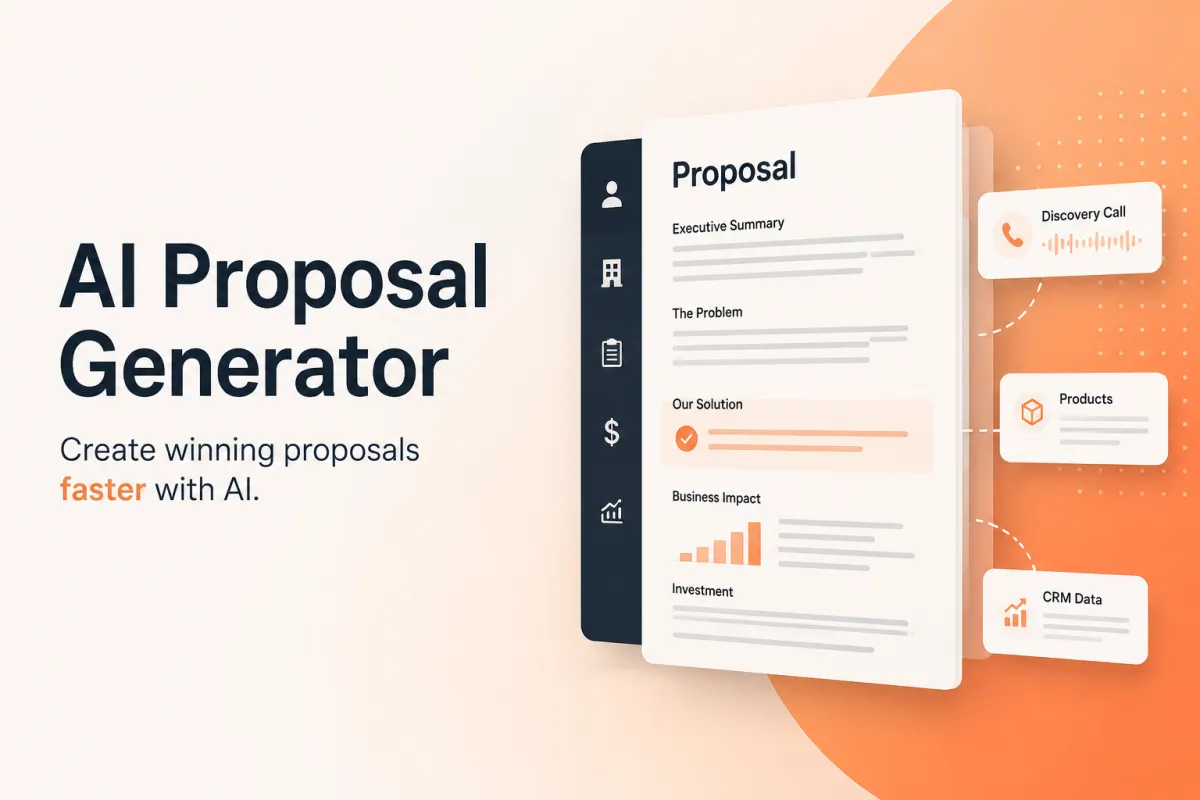
An AI proposal generator is software that drafts a sales proposal automatically from the information a sales team already has: CRM data, past deals, product and pricing details, and, in the more advanced tools, the discovery call itself. Instead of a rep assembling a document from scratch, the tool produces a first draft in minutes, built around what was actually said and positioned.
That speed matters more than it sounds like it should. A prospect’s enthusiasm for a deal doesn’t hold steady while a proposal sits in a rep’s drafting queue. It fades, and the longer the gap between the call and the proposal, the more of that momentum a team gives up.
In this guide, we’ll walk through how these tools actually work, what separates a real AI proposal generator from a template with some fields auto-filled, when adopting one earns its keep, and what to check before you commit to a platform. If you’re a sales leader trying to decide whether this category is worth a demo, or a founder still writing your own proposals at 9 p.m., the goal here is a straight answer, not a pitch.
How Does an AI Proposal Generator Actually Work?
Most tools in this category follow the same basic sequence: information goes in, a draft comes out, a human reviews it, and the proposal goes to the prospect. The differences between platforms show up in what goes into that first step, how much a rep has to do to get from draft to send, and most importantly, the quality of the output.
What It Pulls From
At the simplest level, an AI proposal generator pulls from a CRM record: contact name, company, deal stage, maybe a note field. More capable tools also draw on a library of past proposals, current product and pricing information, and case studies that match the prospect’s industry or use case.
The more advanced tools in this category go a step further and ingest the actual conversation, either a call transcript from an AI notetaker or detailed rep notes. That’s the input that carries the most signal: what the prospect said mattered, what problem they described in their own words, and what they reacted to on the call. A tool limited to CRM fields and a prompt box can still produce a polished document, but it’s working from a much thinner slice of what actually happened between the rep and the buyer.
From Draft to Send-Ready
The typical flow looks like this:
Input goes in. A rep connects a CRM record, uploads a transcript, or fills in a short prompt, depending on the tool.
The AI drafts the proposal. Sections like the problem statement, proposed solution, pricing, the economic value of solving the problems, and next steps get generated automatically, usually in a matter of minutes. Of critical importance is the quality of the writing. If the proposal looks like “AI wrote it”, the prospect will notice and the enthusiasm for your solution erodes.
A human reviews it. This step doesn’t disappear. A rep checks pricing, tone, and accuracy before anything goes to a prospect.
The rep edits as needed. Most tools support quick changes, adjusting a price, swapping a case study, tightening a paragraph, without starting over.
The proposal goes out. Depending on the platform, that’s a shareable link, a PDF, or an exported document a rep can send directly.
The human review step is what keeps this a drafting tool rather than an autopilot. No credible AI proposal generator sends anything without a rep looking at it first.
Where tools diverge further is in what a rep can actually do with the draft once it exists. Some platforms treat the first draft as close to final, with only minor text edits available. Others build in a chat-style interface so a rep can ask for a pricing change, swap a case study, or adjust the tone of a section without touching the underlying document structure. For a team evaluating platforms, this editing flexibility is worth testing directly during a demo rather than taking on faith. A tool that requires a rep to repair obvious “AI slop” or fight the formatting to make a small change will not get used.
What Makes an AI Proposal Generator Different From a Template?
This is a fair objection: a template gets filled in, or needs a rep to manually fill in the blanks every single time. Swap the logo, update the contact name, maybe adjust a paragraph or two, and the rest stays generic. The prospect can always tell and typically loses some interest, as a result.
A genuine AI proposal generator works differently. It reads context, the deal, the conversation, the language the prospect actually used to describe their problem, and adjusts the substance throughout the document, not just the surface details. A pain points section reflects what that specific prospect said on the call. The proposal is grounded in economic value generated by the solution. The case studies pulled in are the ones that match that prospect’s industry or role, not whichever two examples a rep happens to remember using most often. The customized proposal that results looks built for that buyer because it was, not because a mail-merge script swapped out a company name field.
This is also where a lot of AI proposal software platforms fall short. Most tools in the category treat the proposal as a data-assembly problem: pull fields, apply a template, generate polished wording around them. That approach can still beat a blank Word document, but it misses the richest input a B2B sales team has, which is the discovery call itself. A tool that never sees the actual conversation is still filling in a template. It’s just using better language to do it.
Consider two versions of the same deal. A template-based tool pulls the prospect’s company name and industry from the CRM, then drops in a standard set of benefit statements and even a couple of case studies. A conversation-aware tool reads the transcript, sees that the prospect specifically flagged onboarding time as their biggest concern with their current vendor, and builds the proposal’s opening section around that exact pain point, describes the realizable economic value of solving the issue, and pulls a case study that speaks to onboarding speed. The second version reads like it was written specifically for that prospect. The first reads like it was written for the general marketplace.
When Should You Use an AI Proposal Generator?
Sales proposal automation earns its keep in a few specific situations:
High call volume. If your reps are running multiple discovery calls a week, the hours spent assembling proposals by hand add up fast, and that’s time not spent on the next conversation. This volume of proposals leads to whatever can be produced quickly, which translates to generic proposals that don’t fully resonate with buyers.
Small teams without a dedicated proposal writer. Agencies and SaaS teams in the 10 to 150 seller range rarely have a full-time proposal or sales-ops person building custom proposals. An AI proposal generator effectively gives every rep that support.
Deals where speed-to-send affects win rate. In fast-moving B2B sales cycles, a proposal that lands within the hour has a real advantage over one that lands two or three days later, independent of how polished either one is.
It matters less in a narrower set of cases. A single, highly bespoke enterprise Request for Proposal (RFP) that requires weeks of stakeholder input, legal review, and multiple rounds of internal alignment isn’t the use case this category solves best. That kind of deal benefits from AI-assisted drafting at the section level, but the proposal itself is going to be a longer, more collaborative document regardless of the tool behind it.
A useful way to think about it: the more a deal looks like a repeatable motion (discovery call, proposal, close), the more an AI sales proposal tool has to work with. The more a deal looks like a one-off negotiation with a committee, the less any single automated draft will carry the deal on its own. Most B2B teams selling SaaS, services, or agency work run far more of the first kind than the second, which is part of why this category has grown quickly in exactly those segments.
What Should You Look for When Choosing One?
Evaluating an AI proposal software platform comes down to a short list of practical questions, independent of any vendor’s pitch:
Does it draft from real conversation data, or only manual inputs? This is an important quality driver in this category. A tool that only works from typed notes or CRM fields will produce a more generic result than one that can draft from an actual call transcript.
Does the proposal look “like AI wrote it”? This is one of the biggest differentiators in this category. As mentioned above, if a proposal is filled with unearned praise (“What you’ve built is impressive”) and other tell-tale signs such as a series of identically created sentences, it signals to the prospect that the seller may not care enough to invest time in the prospect.
How much editing control do you keep before sending? Every credible tool should support a human review step, plus quick edits to pricing, wording, and content, without forcing a rep to regenerate the whole document from scratch.
What’s the actual security and data-handling posture? If call transcripts or CRM data feed the tool, ask directly how that data is stored, whether it’s used to train AI models, and how it’s isolated between customers. A vague answer here is itself useful information.
Does it integrate with the CRM you already use? A tool that requires manual data entry on top of your existing CRM workflow adds friction instead of removing it. Look for native integration with Salesforce, HubSpot, or whatever system your team already runs deals through.
Red Flags Worth Watching For
A few warning signs are worth flagging before you commit to a platform:
No CRM integrations. If a tool can’t connect to the systems your team already works in, expect manual data entry to eat into whatever time it saves.
Generic-sounding output. If a demo proposal reads as if it could apply to any company in any industry, the underlying model likely isn’t drawing on much beyond a template library.
No human review step. Any tool that sends a proposal without a rep looking at it first is a liability, not a feature.
No clear data handling policy. If a vendor can’t explain plainly how transcript or CRM data is stored and protected, that’s worth treating as a dealbreaker, not a follow-up question for later.
Why Timing Matters More Than Polish
Sales is, at its core, the transfer of enthusiasm. A prospect gets excited about solving a problem, a rep gets excited about the solution, and that shared energy is highest right at the moment the call ends. From there, it has a shelf life.
The prospect goes back to their inbox, their meetings, and their other priorities. Enthusiasm erodes with every day that passes without a next step landing in their hands. A polished proposal that arrives two or three days after the call is competing against a prospect whose attention has already moved on. A good-enough proposal that arrives within the hour is landing while the conversation is still fresh in their mind. Time kills deals, and a proposal sitting in a drafting queue is exactly where that clock keeps running.
This is the real argument for instant proposal generation: not that faster is inherently better, but that the fastest proposals that still meet high quality standards tend to be the ones built directly from what just happened on the call, sent while the prospect can still connect the document to the conversation they just had. A proposal reconstructed from memory and notes a day or two later is working with a colder trail and a cooler prospect, no matter how well-designed the final document looks.
There’s also a practical benefit that has nothing to do with polish: a proposal that lands fast gives the prospect something to act on before their own priorities shift. A champion inside the prospect’s organization, someone who isn’t a professional negotiator and doesn’t love navigating internal approval processes, is far more likely to forward a proposal to their boss the same day they receive it than to dig it out of their inbox a week later after the initial urgency has faded. Once that internal momentum stalls, restarting it usually takes more effort than the original conversation did.
Can an AI Proposal Generator Actually Sound Like Your Team?
This is the objection that stops a lot of sales leaders before they get past the first demo: AI-written proposals read generic, and prospects can tell. It’s a legitimate concern, and it’s also where the underlying training data matters more than the interface. This is a big reason that many attempts to use Gemini, Claude, or ChatGPT to write proposals fall short of expectations and aren’t adopted by companies.
A dynamic proposal tool worth using is trained on a company’s own case studies, value proposition, and past wins, not a shared library of generic business language. The difference shows up in specifics. A generic tool will describe “increased efficiency” and “streamlined workflows.” A tool trained on a company’s actual materials will reference the specific outcomes that the company’s past clients achieved, in the language that the company’s best reps actually use to talk about them.
The output should sound like a company’s strongest seller wrote it on a good day, not like a general-purpose AI model summarizing a product page. That distinction is pattern-level, not tool-specific: any AI proposal generator worth evaluating should be able to explain, in concrete terms, what it’s actually trained on beyond “your CRM data.”
There’s a second, more practical version of this concern worth naming directly: AI writing tells. By now, most buyers have seen enough AI-generated content to recognize the patterns: a string of similarly structured sentences, an unearned compliment early in the document (“what you’ve built is impressive”), phrasing that sounds confident but says very little. A proposal that reads this way undercuts the very momentum it’s supposed to build, no matter how relevant the underlying content is. The tools worth using are the ones built and reviewed, with that specific failure mode in mind, not just optimized to produce grammatically correct paragraphs quickly.
See What a Proposal Built From Your Own Sales Calls Looks Like
If the idea of a proposal built from the actual discovery call, not reconstructed from notes afterward, sounds like the gap in your current process, Revenue Growth Agent’s Solution Proposal Agent is built around exactly that mechanic. It is AI-native rather than AI added onto a template library after the fact, so it drafts a fully personalized proposal from the discovery call transcript itself, within 5 minutes of the meeting, and is trained on your own case studies, solutions, and value proposition.
You can see what that looks like against a transcript from one of your own calls, and decide from there whether the speed and specificity are worth building into your team’s process.

Frequently Asked Questions About AI Proposal Generators
Is an AI-generated proposal actually customized, or just a filled-in template?
It depends on the tool. A template-based approach fills in names and logos around otherwise fixed content. A genuine AI proposal generator reads the specific deal, including the conversation itself where the tool supports it, and adjusts the substance: which pain points get emphasized, which case studies get included, and how the value case is framed for that particular prospect.
How long does it take to generate a proposal with AI?
This varies by platform and by how much conversation data feeds the draft. Tools working only from CRM fields or a prompt box can produce a draft in a few minutes. Tools that draft directly from a call transcript can move even faster. Once a transcript is available, some platforms return a full first draft in under a minute, which means a proposal can realistically be ready to send within five or 10minutes of the call ending, well before a manually assembled version would be.
Do I still need to review a proposal before it goes to a client?
Yes. Every credible AI proposal generator is built around a human review step. The AI produces the first draft; a rep checks pricing, tone, and accuracy, and makes any final edits before it goes out. None of this replaces the rep’s judgment, it removes the hours of manual assembly that used to come before that judgment gets applied.
Can an AI proposal generator work from a call recording or transcript, not just typed notes?
The more advanced tools in this category can, and it’s the single biggest differentiator in the category. A tool that drafts from the actual conversation, via an AI notetaker transcript, captures the prospect’s own language and priorities directly. A tool limited to typed notes or CRM fields is working from a much thinner, more filtered version of what was actually discussed.
Is it secure to feed sales call data into an AI proposal tool?
It depends on the vendor’s architecture and policies, and it’s worth asking directly rather than assuming. Look for clear answers on data isolation between customers, encryption practices, and whether call or CRM data is ever used to train underlying AI models. A vendor that can answer these questions specifically, rather than in general reassurances, is a better sign than the marketing copy on their site.