
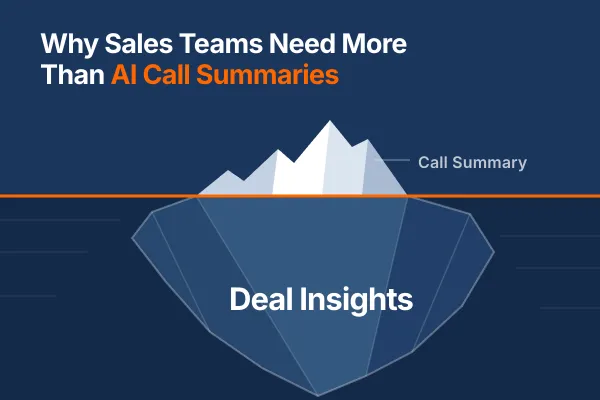
Why B2B Sales Teams Need More Than AI Call Summaries to Improve Deal Decisions
B2B sales teams use AI note-taking and conversational intelligence tools to record, transcribe, and summarize nearly every buyer conversation. Those capabilities make it easier to capture and revisit important information. The next challenge is evaluating what each conversation reveals—and fails to reveal—about qualification, business value, urgency, stakeholders, deal risk, and next steps. Revenue Growth Agent adds this sales-specific context by analyzing discovery insights against a company’s sales methodology and internal knowledge, helping sellers turn useful call summaries into qualification guidance, relevant follow-up, immediate coaching, and preparation for the next buyer conversation.
Key Takeaways
Go beyond call summaries: Deal intelligence evaluates what a conversation means for qualification, business value, risk, and deal progress.
Apply the team’s sales framework: Sales-specific analysis evaluates calls using sales methodology best practices, your qualification criteria, and your value propositions.
Separate facts from gaps: Post-call analysis distinguishes confirmed information from assumptions and identifies unanswered questions.
Coach reps in the moment: AI sales coaching helps sellers address discovery gaps while managers focus on strategy and complex decisions.
Improve the next interaction: Revenue Growth Agent connects discovery analysis to qualification, follow-up, coaching, and meeting preparation.
What Is the Difference Between an AI Call Summary and Deal Intelligence?
An AI call summary and deal intelligence serve related but different purposes.
An AI-generated summary from tools such as Fireflies, Fathom, Otter.ai, Granola, and Plaude can accurately organize the topics discussed, buyer concerns, questions, commitments, and action items from a sales call. Many conversational intelligence platforms can also identify themes, highlight important moments, and provide other useful insights.
Deal intelligence applies an additional layer of sales-specific evaluation to the AI notetaker transcripts. It considers what the conversation means in the context of the organization’s qualification process, sales methodology, solutions, customer evidence, and criteria for advancing an opportunity.
For example, an AI call summary might report that:
The buyer described inconsistent customer data.
Leadership is concerned about reporting accuracy.
The company plans to enter a new market.
The seller agreed to schedule a product demonstration.
A deal-focused analysis would use those facts to ask:
Has the operational or financial impact of the data problem been quantified?
Does the planned expansion create a real deadline for solving the problem?
Which stakeholder owns the issue and controls the budget?
What criteria will the buyer use to evaluate possible solutions?
Does the seller have evidence for each assumption about the opportunity?
What should the rep clarify before or during the next meeting?
AI call summaries explain what was discussed. Deal intelligence evaluates what the discussion reveals—and leaves unresolved—about the opportunity.
Why Useful AI Call Summaries May Still Leave Deal Questions Unanswered
A polished summary can be accurate, detailed, and useful without answering every question a seller needs to advance an opportunity.
That limitation does not mean the AI note-taker performed poorly. A general summary is often designed to provide a concise record of the conversation. It may not be configured to assess the call against a specific qualification framework, distinguish buyer evidence from seller inference, or connect the discussion with the company’s solutions and customer proof.
After reading a summary, a seller may still need to determine:
What business problem did the buyer reveal?
Has the impact of that problem been established?
Why would the buyer need to address it now?
What is the downside cost and risk of not taking action to solve the problems?
Which stakeholders are involved, and which are still missing?
What qualification information remains unclear?
Which assumptions require confirmation?
What could prevent the opportunity from advancing?
What should the rep do before the next conversation?
The issue is not whether AI can summarize a call. The issue is whether the resulting analysis provides the seller with enough context to make better decisions that move a deal forward and reduce the risk of never closing.
How Discovery Insights Can Remain Disconnected in a Call Summary
Buyers rarely describe an entire business problem in one neat statement. The information needed to understand a deal often appears in fragments throughout a conversation.
Suppose a buyer mentions that three departments use different systems to track customer data. Employees manually reconcile conflicting records before producing reports. Those reports sometimes arrive late, and leadership questions whether the numbers are accurate. The company also plans to expand into a new market later in the year.
A summary may capture every one of those details. The seller must still understand how they relate.
Taken together, the comments reveal a broader business problem involving fragmented data, inefficient reporting, limited confidence in decision-making, and operational risk as the company grows. The planned expansion may increase urgency, but the seller should not assume that connection without confirming it with the buyer.
The same challenge applies to business impact, buying criteria, stakeholder influence, deadlines, competitive alternatives, and implementation constraints. Capturing each detail is the foundation. Evaluating the relationships among those details makes the information useful for qualification and deal strategy.
Call data becomes deal intelligence when sellers connect what the buyer said with business value, qualification requirements, deal risk, and next steps.
Why Sales Managers Cannot Provide Immediate Analysis for Every Call
A strong sales manager often supplies the context that a general call summary does not. The manager reviews the conversation, challenges the rep’s conclusions, and asks questions such as:
Did the buyer confirm the impact of the problem?
What evidence suggests the buyer needs to act now?
Who owns or influences the decision?
Which conclusions are customer-verified facts, and which are assumptions?
What information do you still need?
The challenge is scale. Managers cannot review every discovery call and immediately coach every active opportunity.
By the time feedback arrives during a scheduled one-on-one, the rep may already have sent a generic follow-up or entered another meeting without addressing the discovery gaps.
Manager coaching remains essential for deal strategy, judgment, stakeholder dynamics, and complex decisions. AI sales coaching can evaluate discovery completeness and identify missed questions while there is still time to influence the opportunity—and it can do so for every sales call. Because managers cannot review every conversation, AI allows them to focus their limited coaching time on the conversations where their experience and judgment add the most value.
Three Ways AI-Powered Sales Tools Can Add Deal Context to Call Summaries
Sales-focused post-call analysis should build on the call summary by evaluating the quality and completeness of discovery. The analysis should answer three practical questions.
1. What did the seller confirm about the opportunity?
Post-call analysis should identify confirmed information about the buyer’s problems, priorities, business impact, stakeholders, urgency, decision criteria, timing, and desired outcomes. The analysis should also show the evidence supporting those conclusions.
A rep may believe the buyer has an urgent problem, for example, even when the conversation never established a deadline, triggering event, or consequence of inaction. Labeling that conclusion as an assumption helps prevent seller enthusiasm from being mistaken for buyer commitment.
2. What qualification information remains missing or uncertain?
Post-call analysis should expose gaps that could affect qualification or deal progress. A rep may have uncovered pain without quantifying its impact. A buyer may have expressed interest without explaining how the decision will be made. A supportive contact may lack the authority or internal backing needed to move the opportunity forward. These gaps significantly increase the risk that deals end in “no decision.”
For teams using the MEDDIC qualification methodology, automated MEDDIC analysis can help evaluate whether the seller established the relevant metrics, economic buyer, decision criteria, decision process, pain, and internal champion. The same principle applies to other methodologies: analysis is more useful when it reflects how the organization actually qualifies opportunities.
Identifying missing information gives the seller a focused agenda for the next interaction.
3. What should the seller do next?
Deal-focused analysis should translate its findings into action. The rep should leave with specific questions to ask, information to clarify, actions to complete, and relevant proof points to use in the next buyer interaction.
The resulting feedback loop looks like this:
Buyer conversation → call summary → deal analysis → coaching → stronger follow-up → better next conversation
Over time, the same process can help sellers recognize recurring discovery weaknesses, such as failing to quantify pain, moving into solution mode too early, or neglecting to investigate the buyer’s decision process.
What Should Sales Teams Expect From an AI-Powered Deal Review?
Sales teams should evaluate post-call AI by the quality of the decisions and actions it supports, not only by the completeness of its summaries.
A useful AI deal review should help the seller:
Identify meaningful buyer problems and priorities.
Separate confirmed information from seller assumptions.
Evaluate the completeness of qualification.
Surface gaps that could affect deal progress.
Connect buyer needs with relevant solutions and proof.
Prepare specific questions and actions for the next interaction.
Create follow-up that reflects what the buyer actually discussed.
Receive guidance soon enough to act on it.
One question can help a sales team assess whether its post-call analysis goes far enough: After reviewing the output, does the seller understand the opportunity more clearly and know what to do next in order of priority?
A summary can provide an accurate record of the conversation. Deal intelligence should make that record more useful for qualification, strategy, and action.
How Revenue Growth Agent Adds Deal Intelligence to Discovery Call Insights
Revenue Growth Agent (RGA) is designed to carry what a sales team learns in one buyer interaction into the next.
RGA trains on a company’s solutions, value propositions, case studies, testimonials, pricing, sales methodology, and other internal sales knowledge. Its AI agents combine that company context with prospect information and insights from discovery calls.
Sales teams can use RGA to:
Analyze discovery conversations. RGA’s Discovery Conversion Agent evaluates what the rep learned and where discovery remained incomplete.
Identify qualification gaps. The analysis can surface missing information about pain, business impact, stakeholders, decision criteria, timing, and other deal factors.
Distinguish evidence from assumptions. Reps can see which conclusions the buyer confirmed and which still require validation.
Prepare better follow-up questions. Sellers can identify what they need to clarify during the next interaction with a buyer.
Connect buyer needs with relevant proof. RGA can surface applicable capabilities, case studies, testimonials, and value propositions from the company’s sales materials.
Provide immediate AI sales coaching. Reps can identify discovery gaps without waiting for the next one-on-one with their manager.
Prepare for the next meeting. RGA’s Meeting Prepper Agent can combine account intelligence with information already learned about the opportunity to improve preparation.
RGA builds on the information captured across a sequence of conversations with a prospect and applies the company’s sales context, enabling sellers to use it more effectively.
Frequently Asked Questions About Implementing AI-Powered Deal Intelligence
How can a sales team add deal intelligence without replacing its existing AI note-taking tools?
Start by identifying what the current tools already do well and which deal questions remain unanswered after sellers review their call summaries. The team can then add sales-specific analysis where it provides clear value, such as evaluating qualification completeness, identifying unsupported assumptions, and preparing follow-up questions. The best deal intelligence tools leverage transcripts from existing AI notetakers. The goal is to build on existing call data by applying the organization’s sales methodology, qualification criteria, and internal knowledge.
What company information should an AI deal intelligence system use to generate relevant guidance?
An AI deal intelligence system should use the information sellers rely on to understand buyer needs and recommend appropriate solutions. Relevant materials may include solution descriptions, value propositions, case studies, testimonials, pricing information, qualification criteria, and the company’s sales methodology. Combining that internal knowledge with prospect information and buyer-conversation insights helps the system provide guidance aligned with the company’s actual sales process instead of generic sales advice.
How can sales leaders measure whether AI-powered deal intelligence is improving sales performance?
Sales leaders should measure whether deal intelligence changes seller behavior and improves opportunity quality, not simply how many calls the system analyzes. Useful indicators include more complete qualification data, better documentation of business impact, clearer next steps, more relevant follow-up, and fewer opportunities that stall due to missing critical information. Teams can establish a baseline before implementation, track these indicators during a pilot, and compare results across similar reps or opportunity types. The strongest evidence is whether sellers enter buyer conversations better prepared and advance qualified deals with fewer avoidable gaps.
Which sales calls should a team analyze first when piloting AI-powered deal intelligence?
A sales team should begin with calls that contain enough substance to evaluate deal understanding and next-step guidance. Discovery calls are a strong starting point because they reveal how well reps uncover business problems, impact, urgency, stakeholders, decision criteria, and desired outcomes. An initial pilot can focus on a defined set of discovery calls, one sales team, or a specific opportunity type. The team should assess whether the analysis helps reps identify missing information, prepare more relevant follow-up, and enter subsequent buyer conversations with clearer plans.
How Deal Intelligence Builds on AI Call Summaries to Improve Sales Decisions
AI call summaries have made it easier to capture, review, and share buyer conversations. Deal intelligence builds on that progress by applying sales-specific context to the information contained in those conversations. A call summary organizes what the buyer and seller discussed. Deal intelligence evaluates what that discussion means for the opportunity. That evaluation can help a rep determine what the buyer confirmed, what remains uncertain, which qualification gaps matter, and what should happen next. Managers can then spend more of their coaching time on situations that require experience, judgment, and deal strategy. The advantage comes from using captured call insights to improve qualification, strengthen follow-up, guide future conversations, and keep viable opportunities moving.
Turn AI Call Summaries Into Deal Intelligence With Revenue Growth Agent
Revenue Growth Agent helps sales teams apply their methodology and internal sales knowledge to buyer conversations, turning captured call insights into qualification guidance, relevant follow-up, immediate coaching, and preparation for the next meeting.
Schedule a free 30-minute consultation with Revenue Growth Agent to see how RGA could fit your existing sales process.
Prefer to explore the platform yourself? Start a 14-day free trial of Revenue Growth Agent.